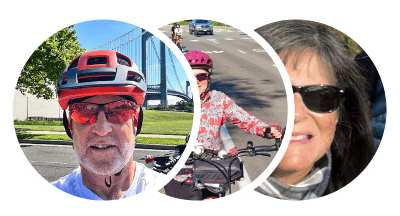


 ElliptiGO bikes are well known as the go-to solution for runners who are dealing with injuries or returning to training after time off. But their value goes far beyond recovery. The smartest runners aren’t just turning to ElliptiGO bikes when something goes wrong. They’re using them proactively to stay healthy, build fitness and maintain consistency.
Young athletes like Michelle Magnani and Meikael Beaudoin Rousseau are embracing ElliptiGO bikes as a key part of their training — not just to come back, but to stay ahead.
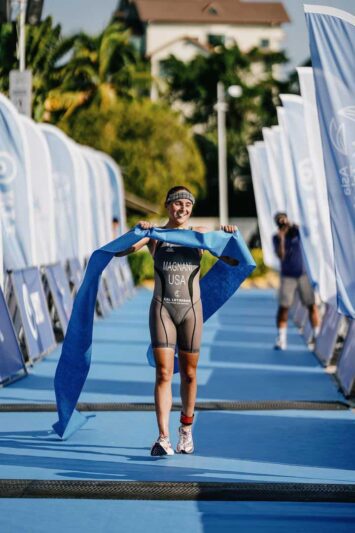
Training for Longevity: Michelle Magnani’s Approach
Professional triathlete Michelle Magnani is currently ranked 7th in the U.S. and top 90 in the world after just three years racing professionally. She says, “My training is built around swimming, cycling, and running, with a strong emphasis on consistency and durability over time.”
Because she races eight to 10 international events each year, managing load, travel and recovery is just as important as the training itself for Michelle. “I’m always looking for ways to stay healthy and keep progressing without interruptions,” she explains.
Michelle first started riding ElliptiGO bikes in college as a way to maintain run-specific fitness without the impact of running. What stood out immediately was how closely the elliptical bike motion mimics running. She says, “It didn’t feel like just additional aerobic work. It felt directly transferable. There’s a strong neuromuscular component to it, which makes a big difference.”
 ElliptiGO cycling has allowed Michelle to maintain high aerobic volume and incorporate intensity while minimizing impact. Still, like many endurance athletes, she has dealt with soft tissue injuries.
“The biggest challenge isn’t just the pain, but the disruption to training rhythm,” Michelle shares. “It can feel like you’re losing fitness quickly, especially leading into races.”
But with her ElliptiGO bike, Michelle can continue to train, even when injured. “I can maintain high aerobic volume and incorporate intensity — threshold efforts, long sessions, even race simulations — without aggravating an injury,” Michelle says. And when something starts to flare up, she substitutes a run or two with an elliptical bike ride and finds that the training effect is very similar.
Now ElliptiGO bikes are part of her strategy. She notes, “It’s become a tool not just for recovery, but for smart load management. You can maintain fitness, reduce stress on your body and extend your training longevity. For endurance athletes, that’s everything.”
From Injury to Comeback: Meikael’s Story
 Professional trail and mountain runner Meikael Beaudoin Rousseau specializes in sub-ultra races that are 50K and under. “Adventuring and pushing my limits have always been a key part of my identity,” he says.
That identity was tested in 2024 after a serious fall during a race left him with a major knee injury.
“Afterwards I couldn’t bike and could barely run,” Meikael explains. “But I didn’t want to give up on my professional running dream, so I took a creative approach to training.”
That meant high-volume cross-training — mostly indoors. With minimal running and lots of time on elliptical machines, Meikael was able to continue performing at a high level in major races, despite his injury. But the hardest part for him was being stuck inside all day, instead of outside where he’d always loved to be.
Everything changed when he took a test ride on an ElliptiGO bike.
 “My first thought was: I wish I’d known about this sooner!” he says. “Words cannot capture the glee and exhilaration I felt over being able to zip around pain-free, outside, after a year of being stuck on indoor machines.”
After getting bilateral knee surgery at the end of 2025, Meikael calls his ElliptiGO 11R “a keystone” in his comeback. He says, “I firmly believe ElliptiGO bikes are the best form of cross training for running. The stride pattern perfectly mimics running mechanics, except it spares your body from the impact. That means you can train harder, longer, and recover better.”
And for Meikael, being outdoors is critical. “From a mental standpoint, the ability to train outside and explore has kept me happier and more motivated than ever with training,” he adds.
Today, his training regimen includes both running and ElliptiGO bike riding almost every day. “I am still in the early stages of building back my running mileage, but even when I hopefully make a full comeback, the ElliptiGO will always be an important part of my training,” he says.
“This injury experience has forever changed the way I approach my training. Even if I was given a perfectly healthy body, I would still choose to spend many hours every week on the ElliptiGO bike because I genuinely believe it makes me a better runner and it’s super fun,” Meikael shares. “To any runner hoping to improve their performance or longevity in the sport, I think it’s one of the best investments you can make!”
Why ElliptiGO Bikes Are the Ideal Cross-Training Tool
ElliptiGO elliptical bikes combine the motion of running with the efficiency of cycling and the low-impact benefits of an elliptical trainer.
That combination provides several unique advantages:
- Run-specific mechanics without impact help reduce stress on joints and soft tissue
- High aerobic output allows athletes to maintain fitness comparable to running workouts
- Indoor and outdoor versatility (with the addition of the ElliptiGO Fluid 365 stationary trainer) allows athletes to stay consistent with training, no matter the weather conditions
- Lower injury risk enables athletes to train longer and more consistently
- Proven benefits include improved fitness, reduced pain, and increased enjoyment
In fact, a 2016 study found that training on an ElliptiGO elliptical bike allowed runners to maintain run-specific fitness, including VO2 Max and running economy, while reducing impact stresses on the body.
And because riding an ElliptiGO bike is a low-impact workout, athletes can maintain their training volume, even when their bodies need a break.
As runner, coach and author Matt Fitzgerald notes, “The ideal cross-training activity for runners is one that closely simulates the running action without impact and is enjoyable. ElliptiGO checks all of these boxes.”
Not Just for Individuals: Teams Are All In
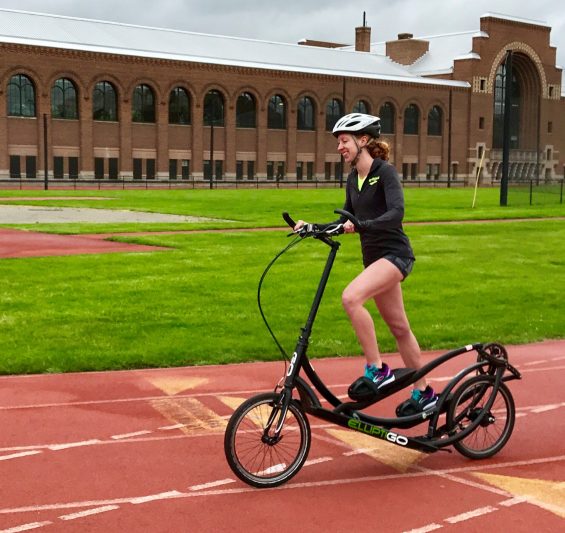 This approach isn’t limited to professional athletes. More than 300 high schools and universities—including programs like Stanford, Michigan and Texas A&M—have integrated ElliptiGO bikes into their training.
Coaches are using ElliptiGO bikes to:
- Keep injured athletes engaged and progressing
- Increase training volume without increasing injury risk
- Maintain team cohesion during recovery periods
- Support return-to-run protocols
For younger athletes, incorporating cross-training early in their careers is a game changer. It builds smarter habits early, prioritizing longevity alongside performance.
A Smarter Way to Train
As top athletes who have embraced the value of cross-training, Michelle and Meikael represent a shift in mindset. They know that ElliptiGO bikes aren’t just something you use when you’re hurt. They’re something you use so you don’t get hurt.
Whether it’s adding low-impact volume, maintaining fitness during injury or simulating race efforts without the impact stresses, the benefits are clear. For today’s athletes, ElliptiGO bikes aren’t a backup plan—they’re a better plan.