

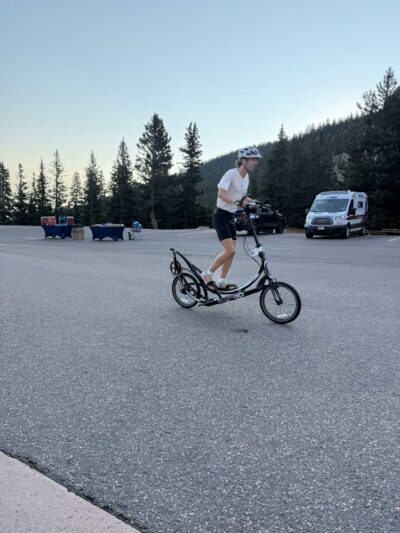
 Brooks-sponsored trail runner Meikael “Meika” Beaudoin-Rousseau has been rebuilding his running career one mile at a time. On Aug. 8, he added an unlikely chapter to that comeback: his first-ever bike race, up Pikes Peak — and he came away with a new ElliptiGO record.
Beaudoin-Rousseau specializes in running sub-ultra trail and mountain races of 50 kilometers and under. It’s the kind of racing where “adventuring and pushing my limits,” as he puts it, are key, and those qualities are central to who he is. But that identity was tested in 2024, when a serious fall during a race left him with a major knee injury, and again at the end of 2025, when he underwent bilateral knee surgery. His ElliptiGO bike has been a critical recovery tool.
A Spontaneous Decision
In the past five months, Beaudoin-Rousseau has logged more than 3,000 miles and over 200,000 feet of climbing on his 11R. “Somewhere along the way,” he says, “the idea of racing on the ElliptiGO seeded itself.”
ElliptiGO CEO Bryce Whiting first put The Broadmoor Cycle to the Summit on his radar, but it wasn’t until the week of the race that Beaudoin-Rousseau could confirm it fit his schedule. “It was a very spontaneous decision to register and go for it,” he says.
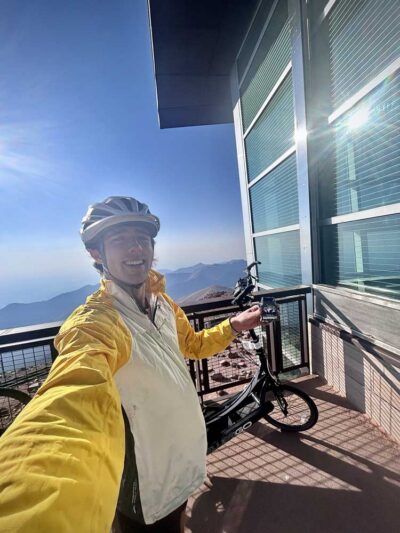
That decision sent him up 12.5 miles of Pikes Peak Highway, climbing roughly 4,700 feet to the 14,115-foot summit. He’d never ridden that stretch of road before. He has, however, run it — the Pikes Peak Ascent trail race has been on his calendar several times, and a strong finish there remains what he calls his “white whale.” Using the ElliptiGO to bank more high-altitude training volume, he says, is part of the plan to arrive better prepared next time he takes on that trail race.
“I Truly Had No Idea What I Was Getting Myself Into”
“Until March of this year, I had probably put on a climbing helmet more times than a bike helmet,” Beaudoin-Rousseau shares. “I did not grow up as a cyclist. So I truly had no idea what I was getting myself into. But the unknowns of the challenge made it particularly exciting!”
With the bike race sandwiched between two big running threshold workouts on his training calendar, he treated it the same way. He says, “I just locked into that same smooth, controlled effort level and used the race as an extra training stimulus. Riding an ElliptiGO is so similar to running, the physical and mental effort felt very comparable to running races.”
Racing an ElliptiGO bike alongside superlight climbing bikes on a 12.5-mile mountain climb put Beaudoin-Rousseau at a built-in disadvantage in the race to the top, but it’s one he embraced. “You definitely have to work comparatively harder on the ElliptiGO, but that’s the whole point,” he says. “I want to push the limits of what can be done on an ElliptiGO bike, and it was fun to ride alongside some pretty fast cyclists all the way to the summit.”
His fellow cyclists encouraged him along the ride. “The cycling community was super supportive and stoked to see an ElliptiGO out there,” he says. “I got a lot of comments like ‘that is incredible,’ and some funny ones like ‘I was feeling good until I got passed by the ElliptiGO!'”
After battling the field and what he described on Instagram as “very much not performance enhancing” 10 mph headwinds, Beaudoin-Rousseau crossed the line in an official time of 1:36:06 — a new ElliptiGO record up Pikes Peak — and placed 11th in the competitive Men 19-29 age category.
Part of a Bigger Comeback
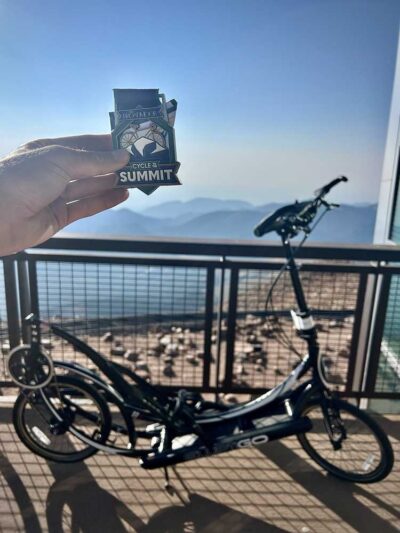 Beaudoin-Rousseau’s Pikes Peak result is the latest milestone in his comeback. After his 2024 race fall, Beaudoin-Rousseau couldn’t bike and could barely run. Rather than give up on his professional running dream, he took what he calls a creative approach: high-volume cross-training, mostly indoors, on traditional elliptical machines. It kept him competitive in major races, but being stuck inside all day wore on him … until he took a test ride on an ElliptiGO bike.
“My first thought was: I wish I’d known about this sooner!” he says. “Words cannot capture the glee and exhilaration I felt over being able to zip around pain-free, outside, after a year of being stuck on indoor machines.”
After his bilateral knee surgery at the end of 2025, Beaudoin-Rousseau leaned on his ElliptiGO 11R as what he calls “a keystone” of his recovery, at times logging as much as 70% of his training volume on it. That foundation helped carry him to a win at the Mount Washington Road Race in June, and now to a record-setting climb up one of Colorado’s most iconic mountains.
What’s Next
Beaudoin-Rousseau isn’t slowing down. He has a packed fall calendar ahead, including Race to the Top of Vermont, Run the Rut Vertical Kilometer, the Pikes Peak Ascent and the Mammoth Trail Fest Ascent, before representing Team USA at the WMRA World Cup Final in Canada. After all that, he’s planning to make an appearance at the ElliptiGO World Championships in October.
For a runner, who not so long ago wasn’t sure when he’d be able to race again, that packed calendar is a great problem to have! From rebuilding after surgery to breaking records on the way back, Meika’s comeback is just beginning. And if the past few months are any indication, there are plenty more milestones ahead.